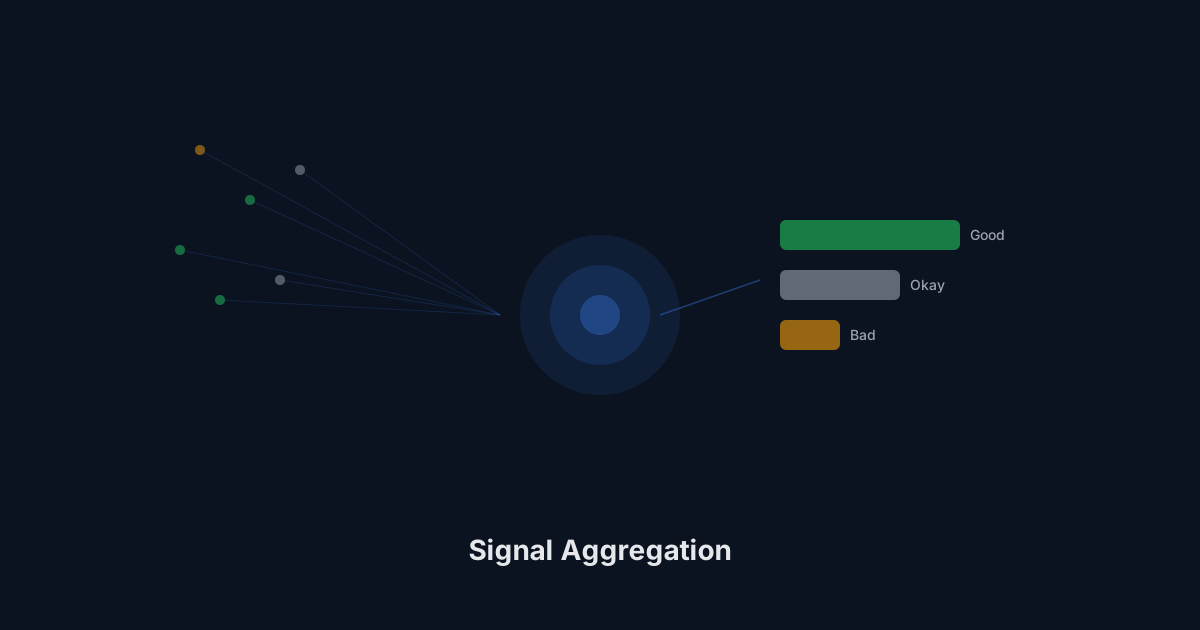
When you open Daily Pulse and see that electricity in your area is "mostly stable" or that traffic is "mostly bad," you are looking at the result of a process called signal aggregation. It sounds technical, but the concept is straightforward: take many individual reports, combine them intelligently, and produce a summary that is more useful than any single report on its own.
This article explains how that process works, why certain design choices were made, and what makes aggregated community data different from traditional monitoring.
What Is a Signal?
In Daily Pulse, a "signal" is a single report from a single person about a single topic at a specific time and place. For example: "Traffic is bad in downtown Beirut at 8:15 AM." That is one signal.
Each signal has three components:
1. Type — What is being reported (traffic, electricity, internet, mobile network, or overall conditions). 2. Response — How the person characterizes it (good, okay, bad, stable, unstable, slow, cut, etc., depending on the signal type). 3. Location — The approximate area where the report was submitted, determined by the device's location services and mapped to a city or neighborhood identifier.
A timestamp is added automatically, and a hashed device identifier is used for rate limiting. That is all the data a signal contains. There is no free text, no photo, no personal information.
From Signals to Insights
A single signal is useful but limited. One person's "bad" might be another person's "okay." One report might come from someone having an unusually bad day. The power of aggregation is that it smooths out individual variation and reveals the underlying reality.
Here is how aggregation works in practice:
Step 1: Collection. Signals arrive from devices across a geographic area over a rolling time window. For real-time insights, the window is typically the current day. For trends, longer windows (weeks or months) are used.
Step 2: Grouping. Signals are grouped by type and location. All electricity reports from a given neighborhood go into one bucket. All traffic reports from the same area go into another.
Step 3: Counting. Within each bucket, the system counts the distribution of responses. If 40 people reported electricity as "stable," 10 as "unstable," and 5 as "cut," those numbers form the basis of the insight.
Step 4: Summarization. The distribution is converted into a human-readable summary. If more than 60% of responses agree, the summary uses "mostly" — "mostly stable," "mostly good," etc. If no response has a clear majority, the summary is "mixed." This approach respects the uncertainty inherent in crowd-sourced data while still being useful.
Step 5: Display. The insight is shown to users in the app, alongside the participant count (how many people contributed) and the distribution breakdown (what percentage said good vs. okay vs. bad).
Why Not Just Average?
A common question is: why not assign numeric values (good = 3, okay = 2, bad = 1) and compute an average? The answer is that averages can be misleading with categorical data.
Consider an area where 50% of people report electricity as "good" and 50% report it as "cut." The average would suggest "okay" — but that completely misses the reality that half the area has no power. A bimodal distribution like this is genuinely "mixed," and calling it "okay" would be dishonest.
By preserving the distribution and using words like "mixed" when there is no consensus, Daily Pulse gives a more accurate picture than a simple average could.
The Role of Sample Size
Aggregated insights are only meaningful when enough people have reported. If only two people have submitted signals for an area, the insight is too fragile to be useful — those two people might not be representative.
Daily Pulse handles this by requiring a minimum number of reports before displaying an insight. Below that threshold, the app shows "Not enough data yet" instead of a potentially misleading summary. This is a deliberate trade-off: it means some areas will not have insights, but the insights that are shown are more trustworthy.
As participation grows, more areas cross the threshold, and the map fills in. This creates a positive feedback loop: people see insights for their area, find them useful, and are motivated to contribute their own reports, which improves the insights further.
Temporal Dynamics
Conditions change throughout the day. Traffic is typically worse during morning and evening commutes. Electricity outages might follow a pattern tied to peak demand hours. Internet quality might degrade in the evening when more people are streaming video.
Daily Pulse captures these temporal dynamics through its hourly trend data. By looking at how signals change over the course of a day, users can identify patterns that a single snapshot would miss. Is the electricity always bad at 6 PM? Is traffic only terrible on weekday mornings? These patterns are visible in the trends view.
Abuse Resistance
Any system that accepts input from anonymous users must be resilient to abuse. Someone might try to flood the system with false reports to distort the picture for a given area.
Daily Pulse mitigates this through several mechanisms. Per-device rate limits cap the number of reports that any single device can submit per signal per day. Per-device hourly rate limits prevent rapid-fire reporting. And the aggregation itself is naturally resistant to outliers — if one device submits "bad" but dozens of others submit "good," the aggregate insight reflects the majority.
These protections work together to ensure that the insights shown to users are a genuine reflection of community experience, not the agenda of any single actor.
The Bigger Picture
Signal aggregation is not just a technical process — it is a form of collective intelligence. When hundreds of people independently report what they are experiencing, the resulting picture is richer, more nuanced, and more timely than anything a single organization could produce.
Every report you submit contributes to this picture. Even if your individual signal feels small, it is part of a larger mosaic that helps your entire community understand the world around them. That is the power of aggregation: turning many small signals into one clear picture.